Physical Security Red Teaming & Adversarial Penetration Testing
The Alesian Group: Connecting Knowledge to Need
Your Trusted Security Management Advisors
Documented security policies, access control readers, and surveillance cameras only provide value if they perform effectively against an active adversary. At The Alesian Group, our physical security red teaming and penetration testing services simulate realistic threat actor tactics, techniques, and procedures (TTPs) to identify latent vulnerabilities before malicious actors exploit them. Whether deployed as a stand-alone operational stress test or integrated into a comprehensive enterprise risk assessment, our ethical penetration exercises measure the true real-world efficacy of your protective countermeasures.
What Is Physical Security Red Teaming?
Physical security red teaming is a goal-oriented, adversarial exercise where certified security practitioners adopt the mindset and methods of an adversary to test an organization's physical boundaries, electronic security measures, and human defenses. Unlike a passive audit or checklist-driven walkthrough, physical penetration testing actively attempts to bypass perimeter controls, defeat mechanical and electronic access points, exploit social engineering vulnerabilities, and access designated mission-critical assets under tightly governed rules of engagement.
Core Red Teaming & Penetration Testing Methodologies
Our adversarial simulations test the multi-layered defenses of your facility through controlled, multi-vector execution:
Adversarial Reconnaissance & OSINT Mapping:
Conducting passive physical surveillance and open-source intelligence (OSINT) gathering to document patrol routines, shift transitions, delivery schedules, and exterior physical vulnerabilities.
Covert Physical Breach & Bypass Testing:
Testing the integrity of perimeter fences, turnstiles, loading docks, and emergency exits using non-destructive mechanical bypass tools, latch-slipping techniques, and request-to-exit (REX) sensor manipulation.
Human Exploitation & Social Engineering:
Evaluating staff awareness and visitor management enforcement through impersonation scenarios (e.g., couriers, contractors, inspectors), badge cloning, tailgating/piggybacking through secure portals, and challenging reception workflows.
Electronic Access Control & Surveillance Stress-Testing:
Evaluating the operational response of security monitoring teams to door-forced-open (DFO) alarms, door-held-open (DHO) notifications, and unauthorized intrusions across video surveillance coverage zones.
Critical Asset Staging & Objective Exfiltration:
Reaching predetermined sensitive spaces—such as executive suites, data center server rooms, high-risk research laboratories, or financial repositories—to validate whether physical protections hold under real conditions
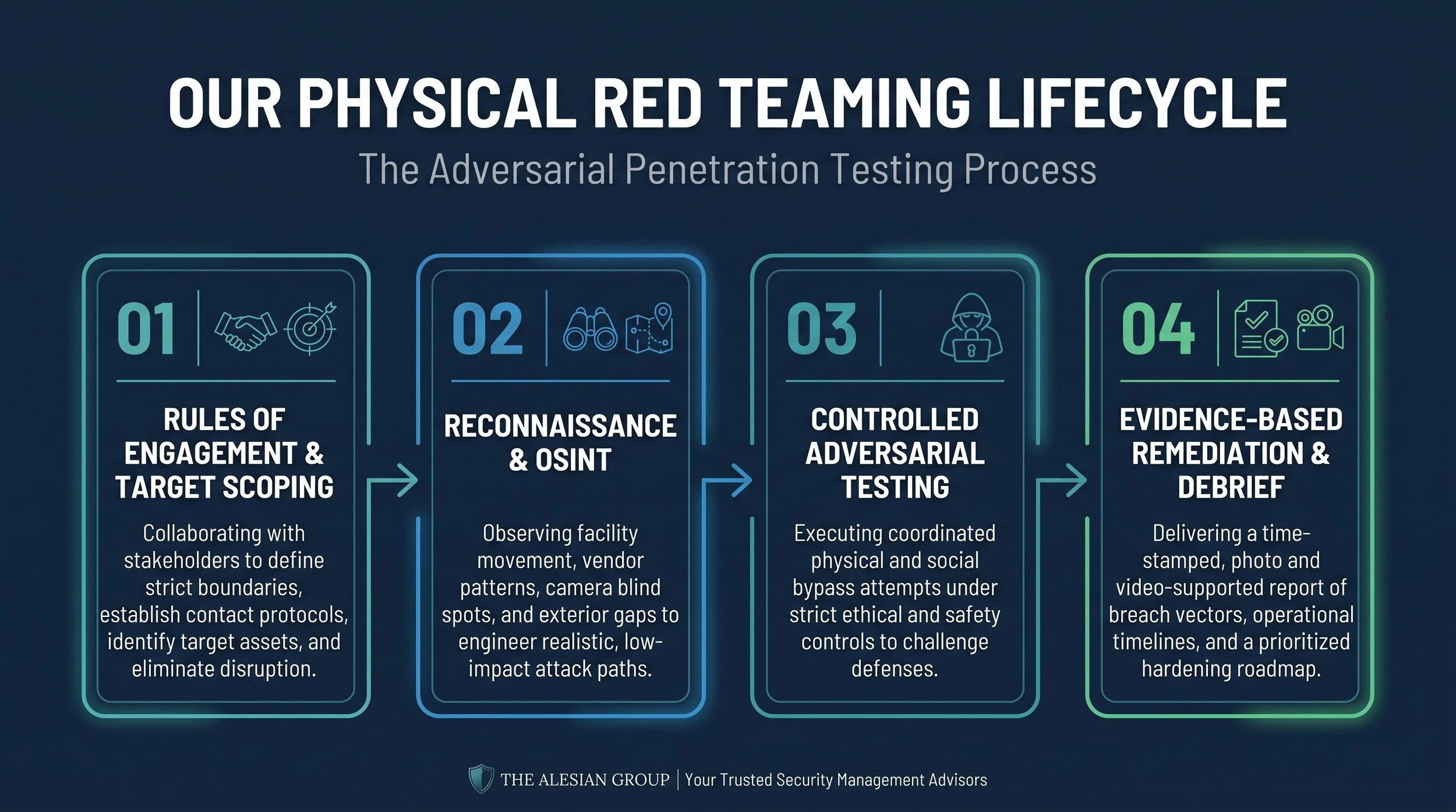
Our 4-Phase Testing Lifecycle
Phase 1: Rules of Engagement (ROE) & Target Scoping
We collaborate with designated executive stakeholders to define strict boundaries, establish emergency contact protocols ("out-of-jail" mechanisms), identify critical target assets, and eliminate disruption to daily operations or life-safety functions.
Phase 2: Reconnaissance & Vulnerability Identification
Our operators observe facility movement, vendor patterns, camera blind spots, and exterior perimeter gaps to engineer realistic, low-impact attack paths.
Phase 3: Controlled Adversarial Testing
Operating under strict ethical and safety controls, our team executes coordinated physical and social bypass attempts to challenge your defenses.
Phase 4: Evidence-Based Remediation & Debrief
We deliver a time-stamped, photographic and video-supported report outlining every breach vector, the operational timeline, and a prioritized remediation roadmap to harden discovered vulnerabilities.