Comprehensive Workplace Violence Prevention & STAAAT™ Active Threat Programs
Specialized Workplace Violence Prevention Services
Led by graduates of the Gavin de Becker & Associates Threat Assessment Training Academy and nationally recognized subject matter experts who regularly publish and keynote on threat management, our advisory team delivers turnkey programmatic solutions:
Workplace Violence Prevention Program (WVPP) Design: Developing defensible policies, operational protocols, and cross-functional response structures aligned with OSHA standards and California SB 553/general industry compliance.
Healthcare Workplace Violence Prevention Programs: Designing defensible violence prevention plans compliant with The Joint Commission (TJC) standards, OSHA healthcare guidelines, and CMS conditions of participation—incorporating emergency department (ED) weapons screening protocols, patient elopement countermeasures, clinical staff de-escalation training, and behavioral emergency response team (BERT) activation workflows.
STAAAT™ Active Threat & Recognition Training: Educating general employees, frontline supervisors, and customer-facing teams on pre-attack indicators, personal safety options, and situationally appropriate protective actions.
Behavioral Threat Assessment Team (BTAT/BTAM) Development: Structuring and mentoring multidisciplinary teams (HR, Legal, Security, Clinical, Operations) across the five core phases: Reporting, Triage, Investigation, Assessment, and Management.
Confidential Reporting Channels & Intake Policies: Designing frictionless, anonymous reporting mechanisms and clear non-retaliation policies that encourage staff to report early leakage without fear of reprisal.
Physical Security & CPTED Architectural Reviews: Auditing access control hardware, physical compartmentalization, reception barriers, and environmental design elements to engineer a physically secure, violence-resistant workplace.
Executive & HR Termination Threat Management: Conducting threat evaluations, coordinating site security safeguards, and developing protective protocols for high-risk employee separations.
The Alesian Group: Connecting Knowledge to Need
Your Trusted Security Management Advisors
Workplace violence has drawn intense scrutiny from regulatory authorities, media outlets, and corporate boards. Guidelines and enforcement from OSHA (including General Duty Clause mandates) make clear that the most effective way to eliminate violent disruptions is through a formal, structured workplace violence prevention program (WVPP) backed by executive leadership buy-in, workforce education, and clearly defined threat management workflows.
At The Alesian Group, our foundational philosophy bridges a common industry misconception: an active shooter or active threat incident is not a separate, random event—it is the extreme manifestation of workplace violence. Because the underlying motivations, grievances, and progression dynamics stem from identical root causes, the same prevention methodologies apply across the entire continuum, empowering organizations to intervene before an incident escalates into physical violence.
The Extreme Workplace Violence Escalation Continuum
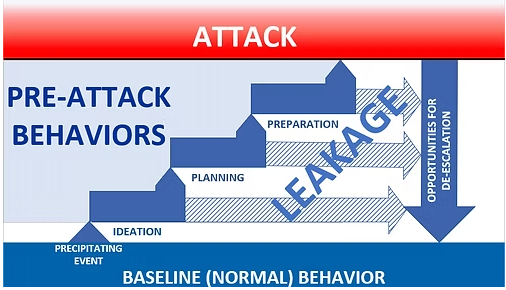
Perpetrators rarely engage in extreme workplace violence without progressing through observable stages of pre-attack behaviors. Research demonstrates that throughout these stages, subjects almost invariably display "leakage"—the intentional or subconscious disclosure of violent intent, fixation, or operational planning through verbal statements, writing, social media posts, or observable behavioral changes.
Recognizing these leakage points provides organizational leaders, human resources, and security teams with clear, actionable windows for intervention and de-escalation:
Baseline (Normal) Behavior: Establishing standard behavioral baselines within your operational culture so that anomalous behaviors are quickly identified.
Precipitating Events: Acute triggers—such as involuntary termination, disciplinary measures, domestic distress, or denied grievances—that initiate grievance collection.
Ideation: The cognitive shift where an individual begins viewing violence as a viable or legitimate means to resolve their perceived grievance.
Planning: Concrete research and reconnaissance, including researching target access, evaluating building schedules, and probing physical security controls.
Preparation: Acquisitive steps such as amassing weapons, staging equipment, or drafting final messages prior to an assault.
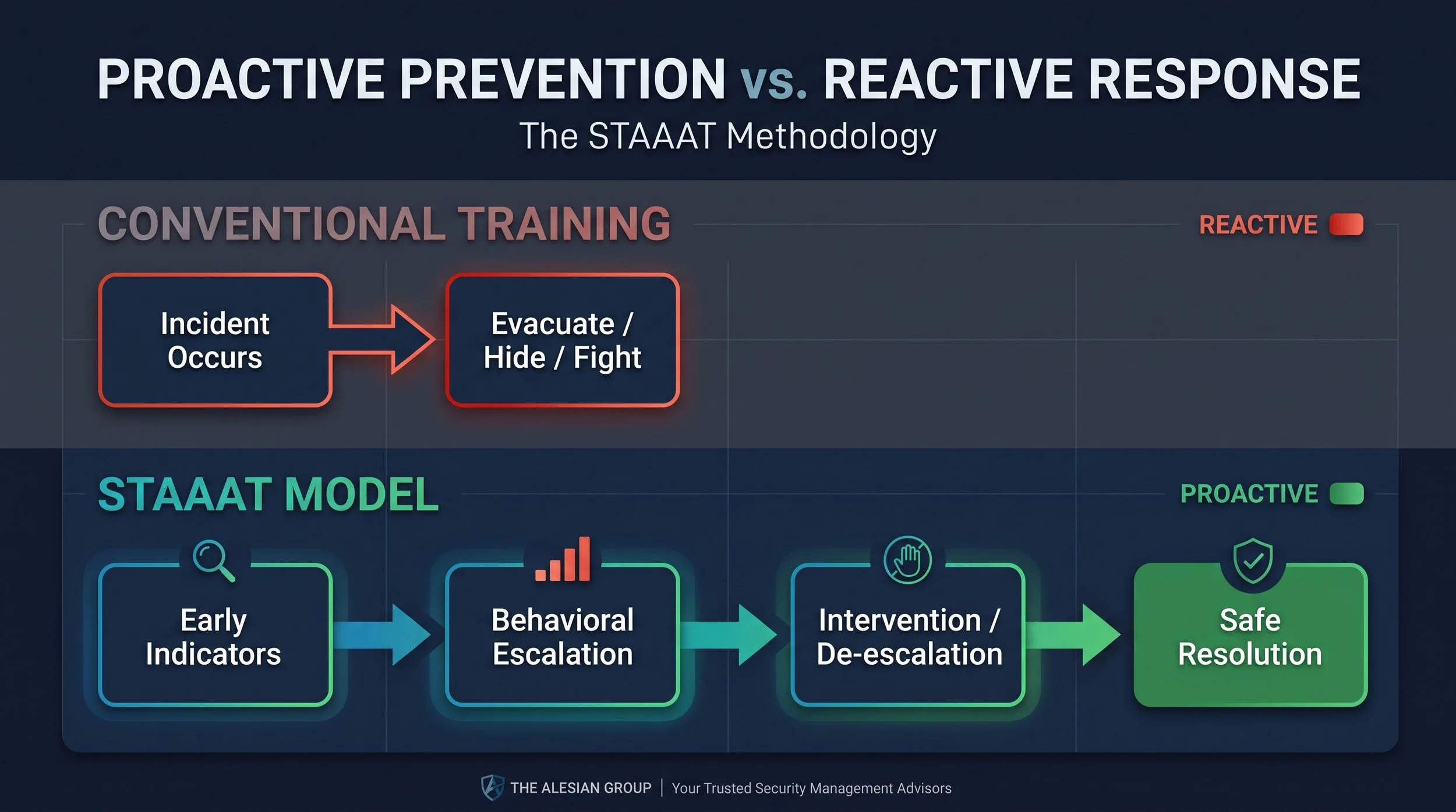
The STAAAT Methodology:
Proactive Prevention vs. Reactive Response
Stage 1: Threat Awareness & Pre-Attack Indicators
Recognizing concerning behaviors, radical grievance collection, unauthorized surveillance, and workplace warning signs.
Stage 2: Threat Assessment & Incident Triage
Evaluating the severity of verbal/physical cues and determining appropriate escalation pathways to internal teams or law enforcement.
Stage 3: Protective Action & Emergency Maneuvers
Executing coordinated, situational options (evacuation, barricading, and last-resort countermeasures) when active threats are imminent.