
connecting the knowledge of security experts to the needs of today’s businesses
-
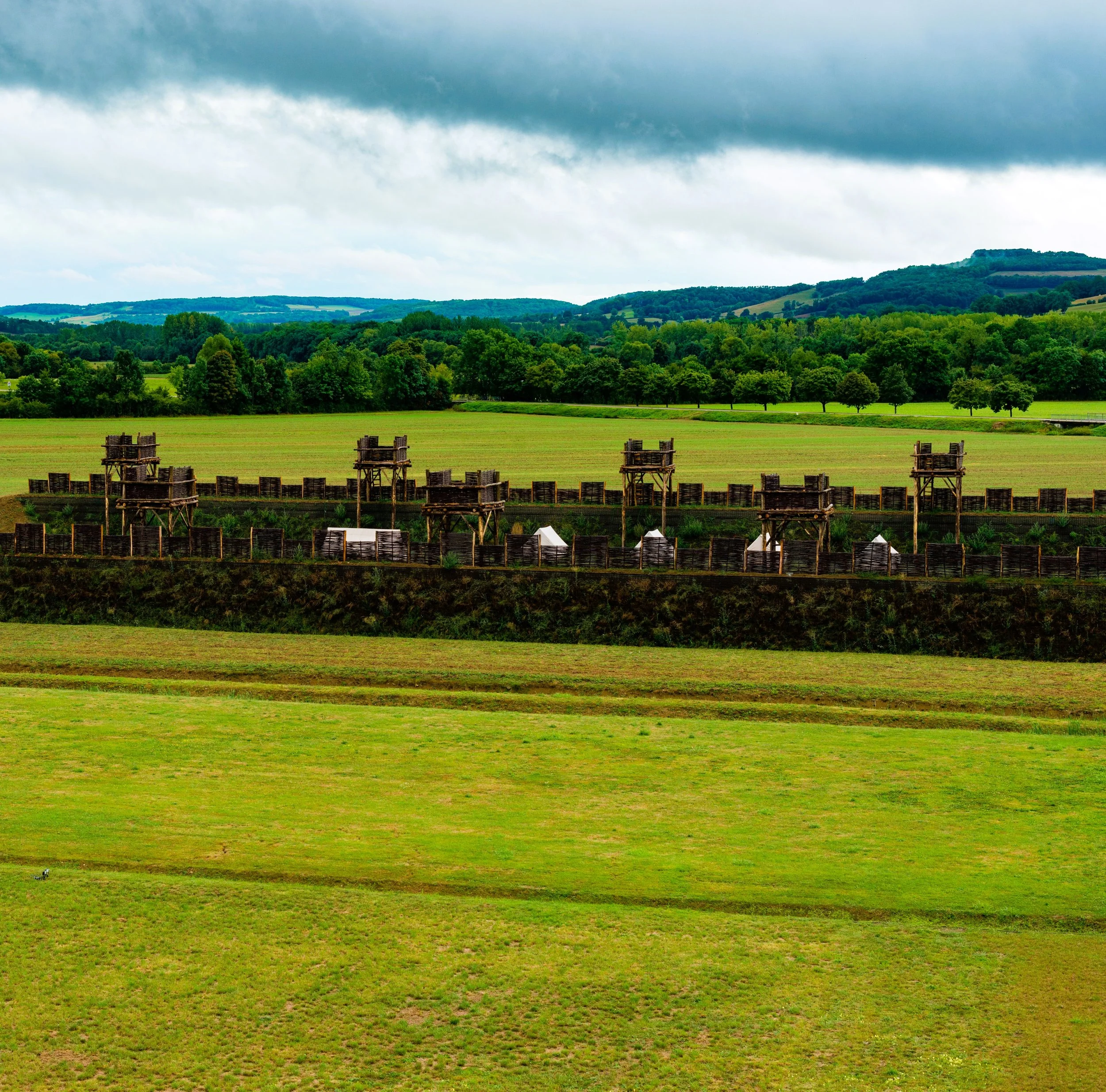
The name The Alesian Group and our brand logo are inspired by one of history’s greatest examples of adaptive defensive strategy: The Battle of Alesia (52 BC).
During a major revolt shortly after the Roman conquest of Gaul, Julius Caesar and his 60,000 legionaries trapped the Gallic leader Vercingetorix and 80,000 troops inside the heavily fortified hilltop city of Alesia (in modern-day France). Recognizing that a direct assault on the stronghold would be disastrous, Caesar initiated a siege. However, Roman intelligence soon discovered that a massive Gallic relief army, numbering up to 250,000 additional warriors, was marching to attack the Romans from behind.
Faced with overwhelming odds on two fronts, Caesar refused to retreat. Instead, he ordered his troops to engineer a groundbreaking, dual-layered defensive fortification known as "investment":
The Circumvallation (Inner Wall): A 10-mile (16 km) ring of fortified walls, watchtowers, and trenches designed to keep Vercingetorix's besieged forces trapped inside.
The Contravallation (Outer Wall): A 13-mile (21 km) external ring of defenses—filled with obstacle fields, traps, and trenches—facing outward to repel the massive oncoming relief force.
By securing his forces within this dual-layered perimeter, Caesar successfully defended his army from both internal sorties and external attacks simultaneously, ultimately forcing Vercingetorix to surrender and securing a historic victory and returning the Gaul to Roman control.
Our Analogy: Protecting Against Dual Threats
In the modern landscape, organizations face an identical dual-threat challenge. A successful enterprise security program must protect its mission-critical assets from both external adversaries (such as trespassers, bad actors, and active threats) and internal vulnerabilities (such as insider threats, workplace violence, compliance gaps, and policy failures).
At The Alesian Group, we help clients build "Alesian" defense systems—layered physical, operational, and behavioral safeguards designed to shield your personnel, property, and assets from multidirectional risk. Our name and our logo serve as daily reminders of our dedication to engineering intelligent, comprehensive, and resilient protective perimeters for those we serve.
-
Unbiased, Vendor-Neutral Assessments: Unlike hardware integrators or guard companies incentivized to sell products or billable hours, an independent consultant sells no hardware, software, or guard labor. This ensures completely objective, conflict-free evaluations of your physical safeguards, premises liability, and vendor performance.
On-Demand Subject Matter Expertise: Hiring an independent advisor gives leadership instant access to board-level Chief Security Officer (CSO) expertise, CPTED certified specialists, and behavioral threat management professionals—without the long-term overhead of adding dedicated full-time executive headcount.
Efficient Project & Capital Scaling: From capital construction projects and Division 28 specifications to emergency workplace violence prevention (WVPP) compliance, a consultant provides dedicated oversight for complex, one-time initiatives to ensure systems are procured efficiently and commissioned correctly
-
Equipment vendors and guard companies frequently recommend products or staffing levels they sell. An independent consultant does not sell hardware or guard services, ensuring that all recommendations, staffing models, and technical specifications are 100% objective, conflict-free, and aligned strictly with your operational needs.
-
Industry standards (such as ASIS International guidelines) recommend a formal physical security program review every 2 to 3 years, or immediately following significant operational changes, facility renovations, executive leadership turnover, or a major security or workplace violence incident.
-
Yes. While often deployed across multi-site campuses or full corporate footprints, targeted assessments can focus specifically on high-consequence assets—such as an executive suite, data center, chemical storage area, cash-handling facility, or research laboratory.
-
A security consultant should be engaged during the Schematic Design (SD) or early Design Development (DD) phase. Early engagement ensures conduit, door hardware coordination, sightlines, and setback requirements are designed into the drawings, avoiding change orders and expensive post-construction redesigns.
-
Fractional management provides instant access to senior, executive-level security expertise without the overhead, recruitment delays, or long-term commitment of a full-time executive. It is an ideal interim solution to maintain stability during vacancies or to establish a mature program foundation before hiring a permanent director.
-
A vulnerability assessment is an overt, collaborative audit that identifies and catalogs theoretical weaknesses across your facility. A red team penetration test is an active, simulated adversarial attack designed to demonstrate whether those vulnerabilities can be practically exploited to defeat physical controls and access critical assets.
All red team operations are bound by strict, mutually approved Rules of Engagement (ROE). We coordinate with a pre-designated "trusted agent" (such as the CSO or General Counsel) who possesses 24/7 communications with our operators, ensuring exercises are paused immediately if real-world safety or business-critical emergencies arise.
-
Traditional programs begin at the point of attack, when lives are already at immediate risk. Situational Threat Awareness Assessment & Action Training (STAAAT) is rooted in behavioral threat management principles and emphasizes early behavioral recognition and communication channels, teaching employees how to identify escalating warning signs so security or threat assessment teams can interdict and de-escalate the issue days or weeks prior to physical violence.